
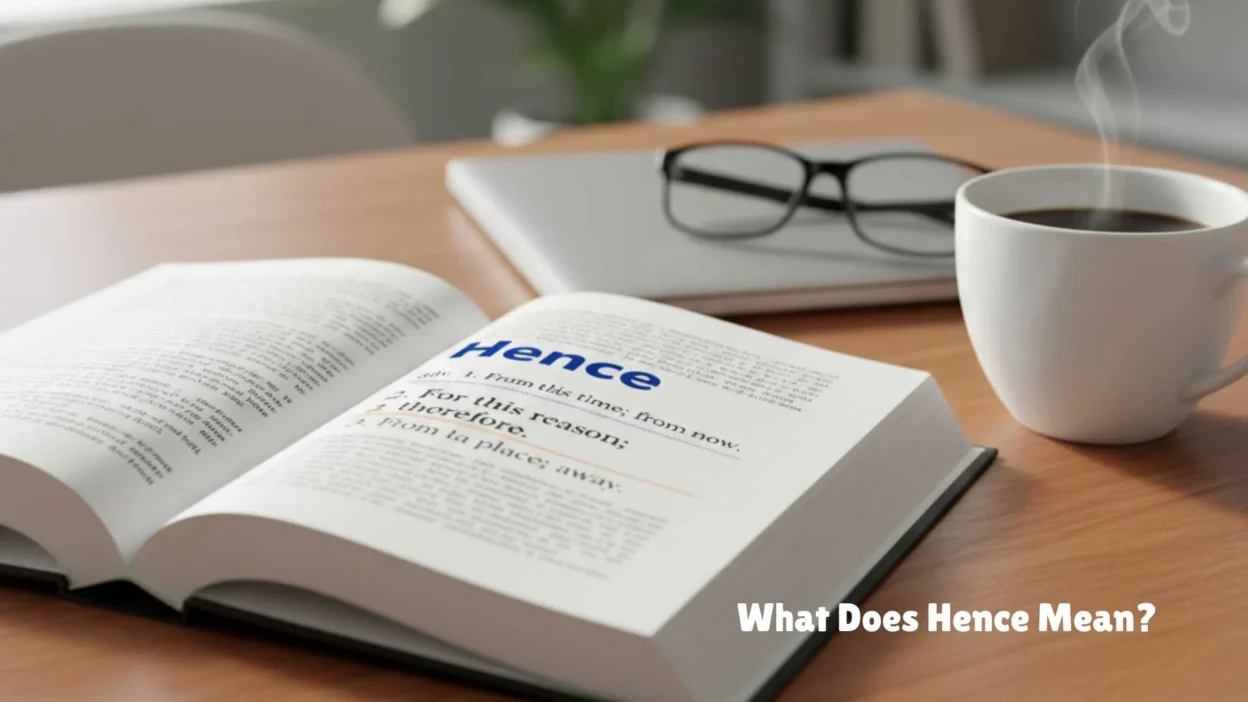
Ever been scrolling through a text or comment and someone suddenly drops the word “hence”, and you pause for a second like… Wait, what does that even mean?
I remember seeing it in a group chat and thinking it was some new Gen-Z shorthand I somehow missed.
Spoiler: it wasn’t slang — just a formal-sounding word being used in a super casual message.
Once I looked it up, it finally clicked.
Quick Answer: “Hence” means “as a result,” “therefore,” or “from this point.”
It’s usually a formal or semi-formal way of showing cause and effect in a sentence.
🧠 What Does “Hence” Mean in Text?
In texting or everyday messages, “hence” is used to show a logical result of something.
It’s basically a fancier version of saying “so,” “therefore,” or “because of that.”
Example:
“I forgot to set my alarm, hence I woke up late.”
It works when you want to sound a bit more polished or when explaining a reason.
In short: Hence = therefore = as a result.
📱 Where Is “Hence” Commonly Used?
You’ll see “hence” mostly in places where people want to sound smart, formal, or precise 😄:
- 📚 Formal texts or essays
- 💼 Work chats or emails
- 💬 WhatsApp or Messenger (by people who type properly!)
- 📘 Academic or study-related groups
- 🧠 Thoughtful social media posts
- 🗣️ Situations where you want to explain a reason clearly
Tone:
- ✔️ Semi-formal
- ✔️ Formal
- ❌ Not usually flirty
- ❌ Rare in casual or meme-style chats
💬 Examples of “Hence” in Conversation
Here are realistic, simple examples to show how “hence” works in real chats:
1.
A: u didn’t come to class today?
B: yeah i wasn’t feeling well, hence the absence.
2.
A: why didn’t you reply last night?
B: slept early, hence i missed ur msg.
3.
A: your project looks so good!
B: thanks! hence the late nights 😭
4.
A: you’re home already?
B: traffic was too much, hence i left early.
5.
A: can you join the meeting?
B: i’m out rn, hence won’t make it.
6.
A: why’s the wifi slow again?
B: too many devices connected, hence the lag.
7.
A: ur camera looks clearer now
B: cleaned the lens, hence better quality lol
🕓 When to Use and When Not to Use “Hence”
✅ When to Use
- When explaining a result
- When you want to sound formal or smart
- In essays, work messages, or academic writing
- When making a logical point
- When giving a reason politely
❌ When Not to Use
- In very casual chats
- In flirty or playful conversations
- During urgent messages (“hence” is too slow-formal)
- When you want quick, simple communication
- When the tone needs to be friendly or chill
Comparison Table
| Context | Example Phrase | Why It Works |
| Friend Chat | “i didn’t sleep well, hence the mood 😅” | Slightly formal but acceptable |
| Work Chat | “The server was down, hence the delay.” | Clear & professional |
| “The files were missing, hence the incomplete report.” | Formal & appropriate | |
| Casual Chat | “i was tired so i didn’t go.” | “So” sounds more natural |
🔄 Similar Slang Words or Alternatives
If “hence” feels too formal, here are simpler, more modern alternatives:
| Word/Slang | Meaning | When to Use |
| So | as a result | Everyday casual chats |
| Therefore | for that reason | Academic or work writing |
| Thus | in this way | Formal explanations |
| ’Cause / cuz | because | Very casual texting |
| Due to this | because of this | Semi-formal messages |
| Consequently | resulting from that | Professional tone |
❓ FAQs About “Hence”
1. Is “hence” considered slang?
No — it’s a real English word, not slang.
2. Is it too formal for texting?
Sometimes yes. It depends on the tone you want.
3. Can I replace “hence” with “so”?
Almost always, yes.
4. Does “hence” mean “because”?
Not exactly — it means “as a result,” which is close.
5. Is it okay to use “hence” in an essay or work email?
Absolutely. It fits perfectly in formal writing.
Meta Description (under 153 characters)


