I still remember the first time I read a short story in school and felt totally lost.
The teacher kept talking about the “conflict” in the story while I sat there wondering what exactly that meant. Was it a fight? A problem? A hidden message?
Later, when I started reading more novels and breaking down plots, I finally understood that “conflict” is the heart of every story — the part that keeps us turning the pages.
Quick Answer: In a story, conflict means the main problem, struggle, or challenge the characters face. It’s the driving force that makes the plot exciting, emotional, or suspenseful.
What Does Conflict Mean in a Story?
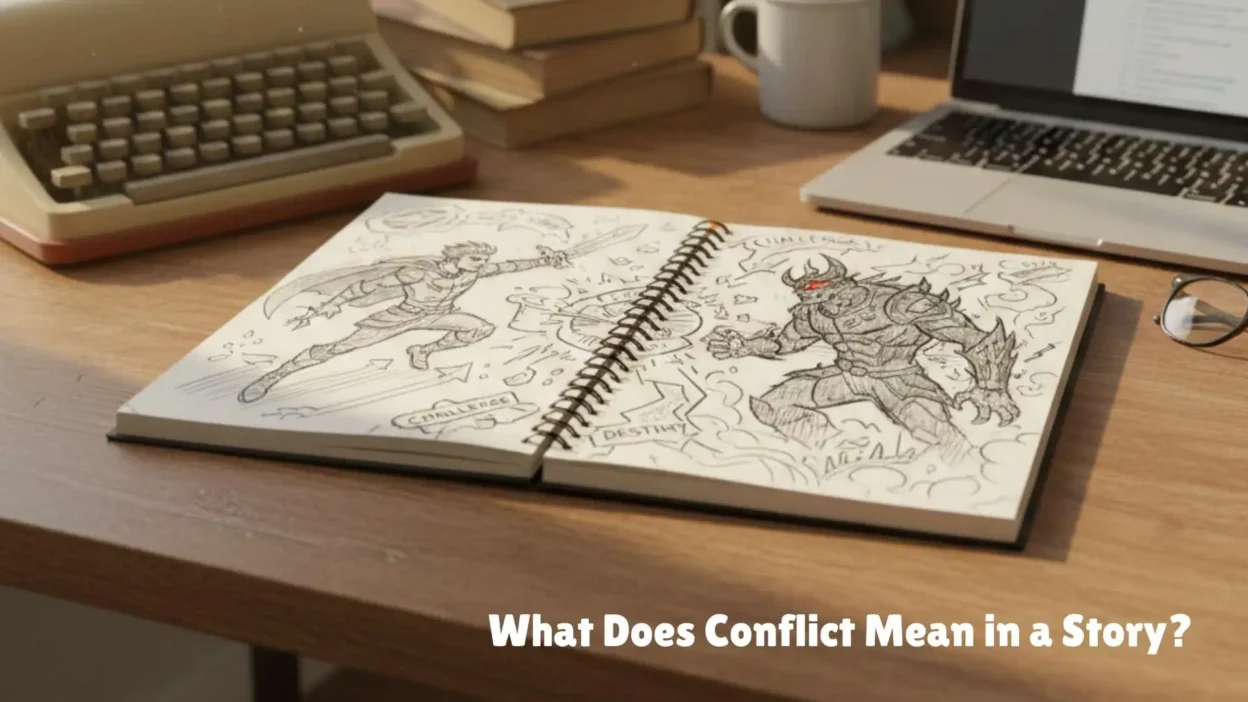
In simple words, conflict is the central problem or struggle in a story. It’s what the character wants versus what stands in their way. Without conflict, a story has no tension and no reason for the reader to stay interested.
Example:
A hero wants to save their village, but a powerful villain stands in the way — that struggle is the conflict.
In short: conflict = the story’s main problem = the force that drives the plot.
Where Is “Conflict” Commonly Used?
You’ll see the term “conflict” in:
- 📚 Story summaries
- 📝 School essays
- 🎬 Movie reviews
- 🧠 Literary analysis
- ✍️ Creative writing
- 🎭 Scriptwriting
- 🎮 Story-based games
It’s a formal and educational phrase, but also very common in creative writing and storytelling discussions.
Examples of “Conflict” in Conversation
A: What’s the conflict in this story?
B: The main character is trying to escape but the doors are locked.
A: Why does this movie feel intense?
B: Because the conflict keeps getting worse.
A: I’m writing a story but it feels boring.
B: Maybe you need a stronger conflict.
A: What’s your essay about?
B: I’m explaining the internal conflict of the main character.
A: Why does the hero seem stressed in chapter 4?
B: That’s when the conflict starts rising.
A: Is there only one conflict?
B: No, some stories have multiple conflicts.
When to Use and When Not to Use “Conflict”
✅ When to Use
- When discussing stories, books, movies, or plots
- When analyzing characters
- In school assignments
- In scriptwriting or storytelling
- When describing tension or problems in fiction
❌ When Not to Use
- When talking informally with friends about real-life small disagreements
- In casual texting
- In emotional or serious real-world situations
- When you mean “argument” or “fight” outside of storytelling
Comparison Table
| Context | Example Phrase | Why It Works |
|---|---|---|
| Literature Class | “The conflict starts when the villain appears.” | Academic and accurate |
| Writing Help | “Your story needs a central conflict.” | Encourages clearer storytelling |
| Movie Review | “The conflict keeps the plot engaging.” | Professional tone |
| Casual Chat | “The conflict makes the story exciting 😄” | Friendly and simple |
Similar Slang Words or Alternatives
| Term | Meaning | When to Use |
|---|---|---|
| Plot Twist | A surprising change in the story | When the story shifts suddenly |
| Rising Action | Events that build tension | When analyzing plot structure |
| Climax | Most intense part of the story | When describing peak drama |
| Tension | Feeling of suspense | When talking about emotional impact |
| Obstacle | A challenge the character faces | When discussing character struggle |
| Dilemma | A tough choice | When characters must choose between options |
FAQs About Conflict in a Story
1. Is conflict the same as the climax?
No. Conflict is the struggle while the climax is the high point of that struggle.
2. Can a story have more than one conflict?
Yes. Many stories include both internal and external conflicts.
3. What are the main types of conflict?
Character vs character, character vs self, character vs society, character vs nature, character vs technology.
4. Does every story need conflict?
Almost always yes. Without conflict, a story feels flat.
5. Is conflict always about fighting?
Not at all. It can be emotional, mental, or situational.
Conclusion
Conflict isn’t just a literary term — it’s the heartbeat of storytelling. It keeps readers invested, helps characters grow, and gives every plot direction and purpose. Whether you’re analyzing a novel for class or writing your own story, understanding conflict helps you unlock the deeper layers of narrative. Once you identify the conflict, the entire story becomes clearer, richer, and more meaningful.