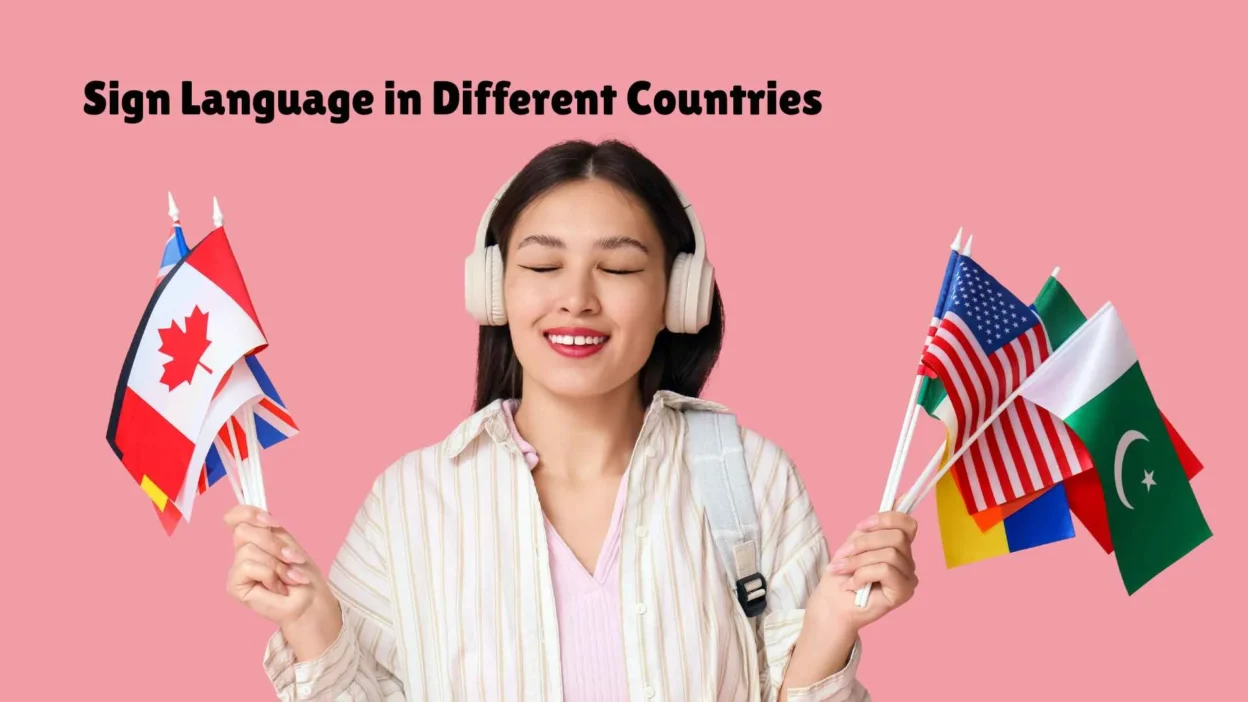
Have you ever wondered whether sign language is the same everywhere? Many people think there’s only one sign language—but the truth is far more beautiful.
Just like spoken languages, sign languages differ from country to country, shaped by culture, history, and community identity.
This guide is written just for you—whether you’re curious, learning, or seeking to understand the deaf community better.
By the end, you’ll know the names of 70 different sign languages used around the world and understand how diverse and rich they truly are.
🌍 Are There Different Languages in Sign Language?
Yes—there are many different sign languages, each with its own grammar, vocabulary, and cultural expressions.
Below are 70 recognized sign languages from around the world.
🖐️ 70 Different Sign Languages Used Around the World
(Note: Sign languages are not spoken languages, so they don’t have “word translations.” Each line gives the name of the sign language + country/region + a short note.)
- ASL – American Sign Language (🇺🇸 USA/Canada) – One of the most widely used sign languages globally.
- BSL – British Sign Language (🇬🇧 UK) – Completely different from ASL.
- Auslan – Australian Sign Language (🇦🇺 Australia) – Closely related to BSL.
- NZSL – New Zealand Sign Language (🇳🇿 New Zealand) – One of the country’s official languages.
- ISL – Indian Sign Language (🇮🇳 India) – Used by millions across India.
- PSL – Pakistani Sign Language (🇵🇰 Pakistan) – Used widely in schools and deaf communities.
- CSL – Chinese Sign Language (🇨🇳 China) – Has strong regional variations.
- JSL – Japanese Sign Language (🇯🇵 Japan) – Known for its rich facial expressions.
- KSL – Korean Sign Language (🇰🇷 South Korea) – Official language since 2015.
- LSF – French Sign Language (🇫🇷 France) – One of the world’s oldest sign languages.
- LSFB – Belgian French Sign Language (🇧🇪 Belgium) – Used in French-speaking regions of Belgium.
- DGS – German Sign Language (🇩🇪 Germany) – Recognized since 2002.
- NGT – Dutch Sign Language (🇳🇱 Netherlands) – Official language since 2020.
- LSC – Catalan Sign Language (🇪🇸 Catalonia) – Distinct from Spanish Sign Language.
- LSE – Spanish Sign Language (🇪🇸 Spain) – Used across Spain with regional varieties.
- SSL – Swedish Sign Language (🇸🇪 Sweden) – Recognized since 1981.
- FSL – Finnish Sign Language (🇫🇮 Finland) – Two versions exist (Finnish & Finland-Swedish).
- TSL – Taiwanese Sign Language (🇹🇼 Taiwan) – Related to Japanese Sign Language.
- HKSL – Hong Kong Sign Language (🇭🇰 Hong Kong) – Strong influence from CSL.
- LSA – Argentine Sign Language (🇦🇷 Argentina) – Used nationwide.
- LSCh – Chilean Sign Language (🇨🇱 Chile)
- LSB – Brazilian Sign Language / Libras (🇧🇷 Brazil) – Official language since 2002.
- LSP – Peruvian Sign Language (🇵🇪 Peru)
- LSCOL – Colombian Sign Language (🇨🇴 Colombia)
- LSM – Mexican Sign Language (🇲🇽 Mexico) – Not mutually intelligible with ASL.
- LSV – Venezuelan Sign Language (🇻🇪 Venezuela)
- URSL – Uruguayan Sign Language (🇺🇾 Uruguay)
- PRSL – Puerto Rican Sign Language (🇵🇷 Puerto Rico)
- GSL – Greek Sign Language (🇬🇷 Greece)
- TSL – Turkish Sign Language (🇹🇷 Türkiye)
- ISL – Israeli Sign Language (🇮🇱 Israel)
- JCS – Jamaican Country Sign (🇯🇲 Jamaica)
- JSL – Jordanian Sign Language (🇯🇴 Jordan)
- KSL – Kenyan Sign Language (🇰🇪 Kenya)
- TSSL – Tanzanian Sign Language (🇹🇿 Tanzania)
- UGSL – Ugandan Sign Language (🇺🇬 Uganda)
- ZSL – Zimbabwe Sign Language (🇿🇼 Zimbabwe) – Constitutionally recognized.
- ASL-Ghana – Ghanaian Sign Language (🇬🇭 Ghana)
- SSL – Somali Sign Language (🇸🇴 Somalia)
- ESL – Ethiopian Sign Language (🇪🇹 Ethiopia)
- RSL – Russian Sign Language (🇷🇺 Russia)
- USL – Ukrainian Sign Language (🇺🇦 Ukraine)
- PSL – Polish Sign Language (🇵🇱 Poland)
- CSL – Czech Sign Language (🇨🇿 Czech Republic)
- SZJ – Slovenian Sign Language (🇸🇮 Slovenia)
- SSL – Slovak Sign Language (🇸🇰 Slovakia)
- NS – Norwegian Sign Language (🇳🇴 Norway)
- DSL – Danish Sign Language (🇩🇰 Denmark)
- ISL – Icelandic Sign Language (🇮🇸 Iceland)
- LSR – Romanian Sign Language (🇷🇴 Romania)
- HSL – Hungarian Sign Language (🇭🇺 Hungary)
- VGT – Flemish Sign Language (🇧🇪 Belgium)
- LSC – Costa Rican Sign Language (🇨🇷 Costa Rica)
- LSN – Nicaraguan Sign Language (🇳🇮 Nicaragua) – A rare language created by children!
- ASL-Liberia – Liberian Sign Language (🇱🇷 Liberia)
- GSL – Georgian Sign Language (🇬🇪 Georgia)
- ASL-Nigeria – Nigerian Sign Language (🇳🇬 Nigeria)
- SSL – South African Sign Language (🇿🇦 South Africa) – Official national language (2023).
- TSL – Thai Sign Language (🇹🇭 Thailand)
- VSL – Vietnamese Sign Language (🇻🇳 Vietnam)
- MSL – Malaysian Sign Language (🇲🇾 Malaysia)
- RSL – Russian Sign Language (🇷🇺 Russia)
- MongSL – Mongolian Sign Language (🇲🇳 Mongolia)
- KSL – Kyrgyz Sign Language (🇰🇬 Kyrgyzstan)
- KSL – Kazakh Sign Language (🇰🇿 Kazakhstan)
- TDSL – Tunisian Sign Language (🇹🇳 Tunisia)
- QSL – Qatari Sign Language (🇶🇦 Qatar)
- UAE SL – Emirati Sign Language (🇦🇪 UAE)
- Oman SL – Omani Sign Language (🇴🇲 Oman)
- Kuwaiti SL – Kuwait Sign Language (🇰🇼 Kuwait)
- Bahrain SL – Bahraini Sign Language (🇧🇭 Bahrain)
- Moroccan SL – Moroccan Sign Language (🇲🇦 Morocco)
🤟 Conclusion
Sign language isn’t universal—and that’s what makes it extraordinary. Every country, every culture, and every deaf community has shaped its own language, full of identity, expression, and beauty. By exploring these 70 sign languages, you’re stepping into a world where communication has no barriers—only possibilities. Keep learning, keep exploring, and let your curiosity connect you with the world.


