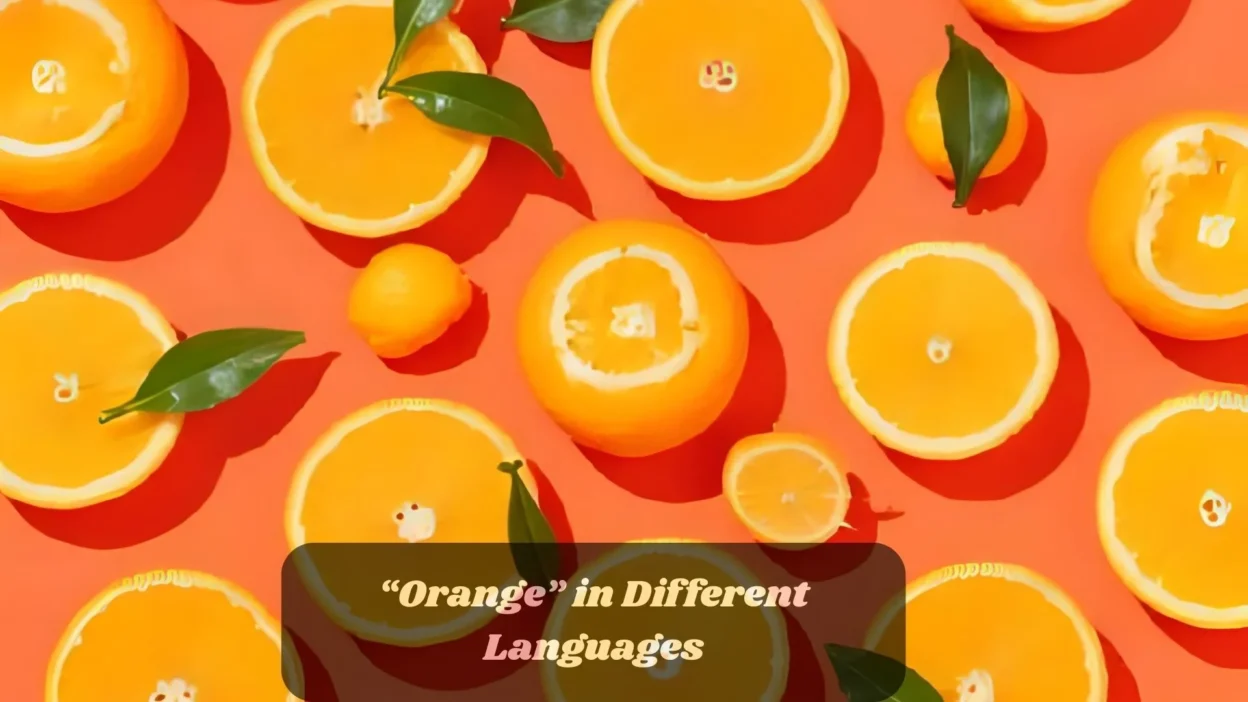
The word “orange” can refer to both a fruit and a color—symbolizing vitality, sunshine, and zest in cultures across the globe.
From sweet citrus groves in Spain to vivid textiles in India, the word “orange” carries flavor and color through languages.
Whether you’re learning a new language or just love the colorful diversity of our world, here are 70 translations of “orange” with pronunciation and usage examples.
🔢 70 Translations of “Orange” in Different Languages
- English – Orange (OR-inj)
She wore an orange dress. - Spanish – Naranja (nah-RAHN-hah)
Me gusta el jugo de naranja. (I like orange juice.) - French – Orange (oh-RAHNJ)
Il a une chemise orange. (He has an orange shirt.) - German – Orange (oh-RAHN-guh)
Ich esse eine Orange. (I’m eating an orange.) - Italian – Arancia (ah-RAHN-chah) *(fruit), Arancione (ah-rahn-CHOH-neh) (color)
L’arancia è dolce. (The orange is sweet.) - Portuguese – Laranja (lah-RAHN-zhah)
Eu gosto de laranja. (I like orange.) - Dutch – Oranje (oh-RAHN-yuh)
Ik hou van oranje. (I love orange.) - Swedish – Apelsin (ah-pehl-SEEN) *(fruit), Orange (oo-RAHNJ) (color)
- Norwegian – Appelsin (ahp-pel-SEEN)
- Danish – Appelsin (ap-el-SEEN)
- Finnish – Appelsiini (ahp-pel-SEE-nee)
- Estonian – Apelsin (AH-pel-seen)
- Latvian – Apelsīns (ah-pel-SEENS)
- Lithuanian – Apelsinas (ah-pel-SEE-nas)
- Polish – Pomarańcza (po-ma-RAHN-cha)
- Czech – Pomeranč (po-meh-RAHNCH)
- Slovak – Pomaranč (po-ma-rahnch)
- Hungarian – Narancs (NAH-rahnch)
- Romanian – Portocală (por-to-KAH-luh)
- Greek – Πορτοκάλι (por-to-KAH-lee)
- Russian – Апельсин (a-pyel’-SEEN)
- Ukrainian – Апельсин (a-pel’-SEEN)
- Belarusian – Апельсін (a-pel’-SEEN)
- Bulgarian – Портокал (por-to-KAL)
- Serbian – Поморанџа (po-mo-RAN-dja)
- Croatian – Naranča (nah-RAHN-cha)
- Slovenian – Pomaranča (po-ma-RAHN-cha)
- Bosnian – Narandža (na-RAN-dzha)
- Macedonian – Портокал (por-to-KAL)
- Albanian – Portokall (por-to-KALL)
- Turkish – Portakal (por-ta-KAL)
- Arabic – برتقال (burtuqaal)
- Hebrew – תפוז (tapooz)
- Persian (Farsi) – پرتقال (porteghal)
- Hindi – संतरा (santara)
- Urdu – سنترہ (santra)
- Bengali – কমলা (komola)
- Punjabi – ਸੰਤਰਾ (santra)
- Gujarati – નારંગી (narangi)
- Marathi – संत्रं (santra)
- Tamil – ஆரஞ்சு (ārañcu)
- Telugu – కమలాపండు (kamalāpandu)
- Kannada – ಕಿತ್ತಳೆ ಹಣ್ಣು (kittaḷe haṇṇu)
- Malayalam – ഓറഞ്ച് (oran̄c)
- Sinhala – තැඹිලි (thambili)
- Thai – ส้ม (sôm)
- Lao – ໝາກສ້ມ (mak som)
- Vietnamese – Cam (kahm)
- Khmer – ក្រូច (krouch)
- Chinese (Mandarin) – 橙子 (chéngzi)
- Japanese – オレンジ (orenji)
- Korean – 오렌지 (o-ren-ji)
- Mongolian – Жүрж (jurj)
- Tibetan – འབྲུག་པོ་ (drukpo)
- Malay – Oren (OH-ren)
- Indonesian – Jeruk (juh-ROOK)
- Tagalog – Kahel (kah-HEL)
- Hawaiian – ʻAlani (ah-LAH-nee)
- Samoan – Lanu moli (LAH-noo MO-lee)
- Maori – Karaka (kah-rah-kah)
- Swahili – Chungwa (CHOONG-wah)
- Zulu – Iwolintshi (ee-wo-lin-chee)
- Xhosa – Iwolintshi (ee-wo-lin-chee)
- Yoruba – Osan (oh-sahn)
- Igbo – Ọsụ (aw-su)
- Hausa – Lemun Tsami (leh-moon tsa-mee)
- Amharic – ብርቱካን (birtukan)
- Somali – Liin dhanaan (leen dha-naan)
- Afrikaans – Lemoen (le-MOON)
- Esperanto – Oranĝo (oh-RAN-jo)
🧡 Final Thought
From citrus fruits to colors on a painter’s palette, “orange” brightens up life in every language. Learning how to say this vibrant word across cultures not only enhances your vocabulary but also adds color to your cultural knowledge. Whether you’re sipping juice in Spain or admiring a sunset in Thailand, orange is a universal burst of life.
“The world may speak in different tongues, but the zest of an orange is understood by all.”