
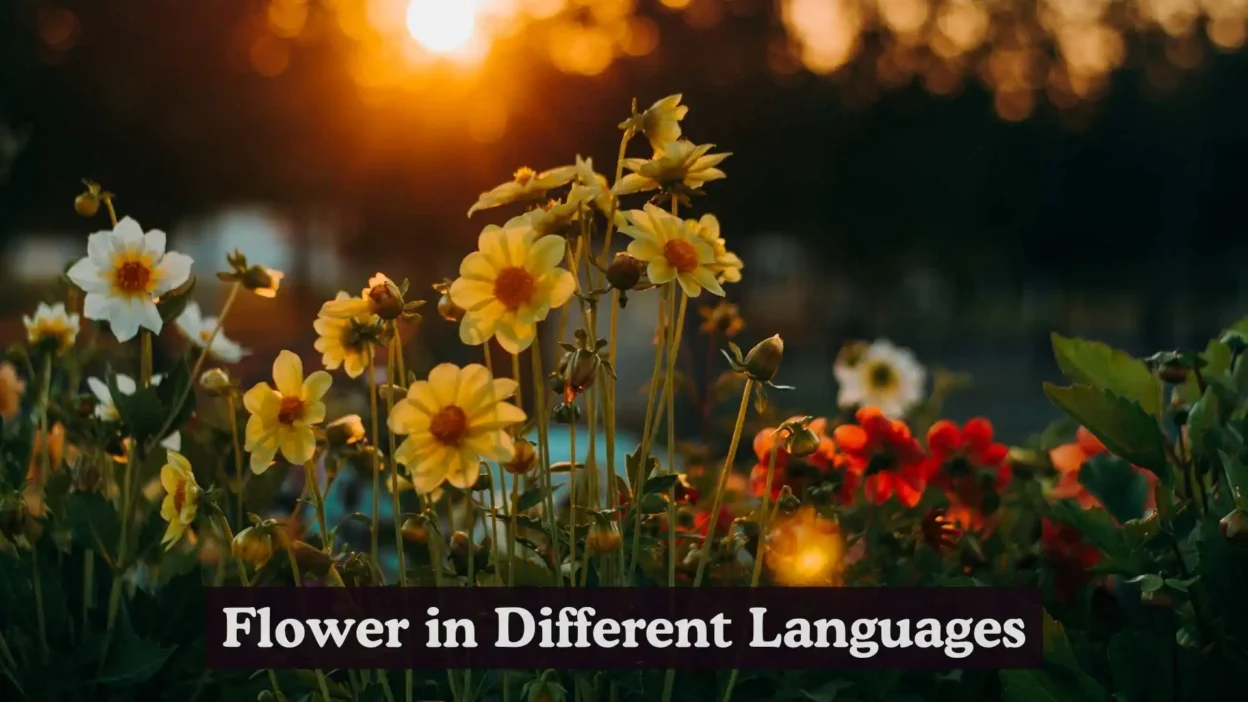
Flowers have a special way of speaking to the heart, no matter where you are in the world.
Have you ever wondered how to say “flower” in different languages?
In this article, we’ll explore Flower in Different Languages — from the familiar to the exotic, with pronunciations and examples to make it easy to remember.
This guide is crafted just for you, to celebrate the beauty of nature through words.
By the end, you’ll see how one simple word can bloom in countless ways across cultures.
🌷 How to Say “Flowers” in 70 Different Languages
- English (🇺🇸) – Flowers | Pronunciation: flau-ers
Example: The garden is full of flowers. - Spanish (🇪🇸) – Flores | Pronunciation: flo-res
Example: El jardín está lleno de flores. (The garden is full of flowers.) - French (🇫🇷) – Fleurs | Pronunciation: flur
Example: Le jardin est rempli de fleurs. (The garden is full of flowers.) - German (🇩🇪) – Blumen | Pronunciation: bloo-men
Example: Der Garten ist voller Blumen. (The garden is full of flowers.) - Italian (🇮🇹) – Fiori | Pronunciation: fee-oh-ree
Example: Il giardino è pieno di fiori. (The garden is full of flowers.) - Portuguese (🇵🇹) – Flores | Pronunciation: flo-res
Example: O jardim está cheio de flores. (The garden is full of flowers.) - Russian (🇷🇺) – Цветы (Tsvety) | Pronunciation: tsveh-tee
Example: Сад полон цветов. (Sad polon tsvetov.) – The garden is full of flowers. - Chinese (Mandarin) (🇨🇳) – 花 (Huā) | Pronunciation: hwa
Example: 花园里有很多花。 (Huāyuán li yǒu hěn duō huā.) – The garden has many flowers. - Japanese (🇯🇵) – 花 (Hana) | Pronunciation: ha-na
Example: 庭には花がたくさんあります。 (Niwa ni wa hana ga takusan arimasu.) – There are many flowers in the garden. - Korean (🇰🇷) – 꽃 (Kkot) | Pronunciation: kkot
Example: 정원에는 꽃이 많아요. (Jeongwoneneun kkot-i manayo.) – There are many flowers in the garden. - Hindi (🇮🇳) – फूल (Phool) | Pronunciation: phool
Example: बगीचे में फूल हैं। (Bagiche mein phool hain.) – There are flowers in the garden. - Arabic (🇸🇦) – زهور (Zuhur) | Pronunciation: zu-hoor
Example: الحديقة مليئة بالزهور. (Al-hadiqa mali’a bil-zuhur.) – The garden is full of flowers. - Bengali (🇧🇩) – ফুল (Phul) | Pronunciation: phool
Example: বাগানে অনেক ফুল আছে। (Bagane onek phul ache.) – There are many flowers in the garden. - Urdu (🇵🇰) – پھول (Phool) | Pronunciation: phool
Example: باغ میں بہت سارے پھول ہیں۔ (Bagh mein bohat saare phool hain.) – There are many flowers in the garden. - Turkish (🇹🇷) – Çiçekler | Pronunciation: chee-chek-ler
Example: Bahçe çiçeklerle dolu. (The garden is full of flowers.) - Greek (🇬🇷) – Λουλούδια (Louloudia) | Pronunciation: loo-loo-thee-a
Example: Ο κήπος είναι γεμάτος λουλούδια. (The garden is full of flowers.) - Dutch (🇳🇱) – Bloemen | Pronunciation: bloo-men
Example: De tuin staat vol bloemen. (The garden is full of flowers.) - Swedish (🇸🇪) – Blommor | Pronunciation: blom-mor
Example: Trädgården är full av blommor. (The garden is full of flowers.) - Finnish (🇫🇮) – Kukat | Pronunciation: koo-kat
Example: Puutarha on täynnä kukkia. (The garden is full of flowers.) - Polish (🇵🇱) – Kwiaty | Pronunciation: kfya-tee
Example: Ogród jest pełen kwiatów. (The garden is full of flowers.) - Czech (🇨🇿) – Květiny | Pronunciation: kveh-tee-nee
Example: Zahrada je plná květin. (The garden is full of flowers.) - Hungarian (🇭🇺) – Virágok | Pronunciation: vee-rah-gok
Example: A kert tele van virágokkal. (The garden is full of flowers.) - Romanian (🇷🇴) – Flori | Pronunciation: flo-ree
Example: Grădina este plină de flori. (The garden is full of flowers.) - Mandarin Chinese (🇨🇳) – 花 (Huā) | Pronunciation: hwa
Example: 花园里有很多花。 (Huāyuán li yǒu hěn duō huā.) – The garden has many flowers. - Japanese (🇯🇵) – 花 (Hana) | Pronunciation: ha-na
Example: 庭には花がたくさんあります。 (Niwa ni wa hana ga takusan arimasu.) - Korean (🇰🇷) – 꽃 (Kkot) | Pronunciation: kkot
Example: 정원에는 꽃이 많아요. (Jeongwoneneun kkot-i manayo.) - Indonesian (🇮🇩) – Bunga | Pronunciation: boon-ga
Example: Taman penuh dengan bunga. (The garden is full of flowers.) - Malay (🇲🇾) – Bunga | Pronunciation: boon-ga
Example: Taman penuh dengan bunga. (The garden is full of flowers.) - Vietnamese (🇻🇳) – Hoa | Pronunciation: hwa
Example: Vườn đầy hoa. (The garden is full of flowers.) - Thai (🇹🇭) – ดอกไม้ (Dokmai) | Pronunciation: dok-mai
Example: สวนเต็มไปด้วยดอกไม้ (The garden is full of flowers.) - Filipino (🇵🇭) – Bulaklak | Pronunciation: boo-lak-lak
Example: Ang hardin ay puno ng bulaklak. (The garden is full of flowers.) - Swahili (🇰🇪) – Maua | Pronunciation: ma-oo-ah
Example: Bustani imejaa maua. (The garden is full of flowers.) - Zulu (🇿🇦) – Izimbali | Pronunciation: ee-zim-ba-lee
Example: Ingadi igcwele izimbali. (The garden is full of flowers.) - Hebrew (🇮🇱) – פרחים (Prachim) | Pronunciation: pra-kheem
Example: הגן מלא בפרחים. (The garden is full of flowers.) - Persian (🇮🇷) – گلها (Gol-ha) | Pronunciation: gol-ha
Example: باغ پر از گل است. (The garden is full of flowers.) - Urdu (🇵🇰) – پھول (Phool) | Pronunciation: phool
Example: باغ میں پھول ہیں۔ (The garden has flowers.) - Bengali (🇧🇩) – ফুল (Phul) | Pronunciation: phool
Example: বাগানে অনেক ফুল আছে। (There are many flowers in the garden.) - Tamil (🇮🇳) – பூக்கள் (Pookkal) | Pronunciation: poo-kal
Example: பூங்கா பல பூக்களால் நிரம்பியுள்ளது. (The park is full of flowers.) - Telugu (🇮🇳) – పూలు (Poolu) | Pronunciation: poo-loo
Example: తోటలో పూలు ఉన్నాయి. (The garden has flowers.) - Kannada (🇮🇳) – ಹೂವುಗಳು (Hoovugalu) | Pronunciation: hoo-voo-ga-lu
Example: ತೋಟದಲ್ಲಿ ಹೂವುಗಳಿವೆ. (The garden has flowers.) - Malayalam (🇮🇳) – പുഷ്പങ്ങൾ (Pushpangal) | Pronunciation: poosh-pan-gal
Example: പൂന്തോട്ടം പുഷ്പങ്ങളാൽ നിറഞ്ഞിരിക്കുന്നു. (The garden is full of flowers.) - Sinhala (🇱🇰) – මල් (Mal) | Pronunciation: mal
Example: වත්ත මල් වලින් පිරී ඇත. (The garden is full of flowers.) - Burmese (🇲🇲) – ပန်းများ (Pan Myar) | Pronunciation: pan myar
Example: ပန်းခြံတွင် ပန်းများစွာရှိသည်။ (The garden has many flowers.) - Khmer (🇰🇭) – ផ្កា (Phka) | Pronunciation: ph-ka
Example: ផ្ទះសួនពោរពេញទៅដោយផ្កា។ (The garden is full of flowers.) - Lao (🇱🇦) – ດອກໄມ້ (Dokmai) | Pronunciation: dok-mai
Example: ສວນເຕີມໄປດ້ວຍດອກໄມ້. (The garden is full of flowers.) - Mongolian (🇲🇳) – Цэцэг (Tsetseg) | Pronunciation: tset-seg
Example: Цэцэрлэгт олон цэцэг байна. (The garden has many flowers.) - Kazakh (🇰🇿) – Гүлдер (Gulder) | Pronunciation: gool-der
Example: Бақта гүлдер көп. (The garden has many flowers.) - Uzbek (🇺🇿) – Gul | Pronunciation: gool
Example: Bog‘da gul bor. (The garden has flowers.) - Tajik (🇹🇯) – Гулҳо (Gulho) | Pronunciation: gool-ho
Example: Боғ пур аз гулҳост. (The garden is full of flowers.) - Georgian (🇬🇪) – ყვავილები (Qvavilebi) | Pronunciation: kva-vi-le-bi
Example: ბაღში ბევრი ყვავილია. (The garden has many flowers.) - Armenian (🇦🇲) – Ծաղիկներ (Tsaghikner) | Pronunciation: tsa-ghik-ner
Example: Այգին լի է ծաղիկներով. (The garden is full of flowers.) - Ukrainian (🇺🇦) – Квіти (Kvity) | Pronunciation: kvee-tee
Example: Сад повний квітів. (The garden is full of flowers.) - Serbian (🇷🇸) – Цвети (Cvjeti) | Pronunciation: tsvye-tee
Example: Врт је пун цвети. (The garden is full of flowers.) - Croatian (🇭🇷) – Cvijeće | Pronunciation: tsvee-eh-che
Example: Vrt je pun cvijeća. (The garden is full of flowers.) - Bosnian (🇧🇦) – Cvijeće | Pronunciation: tsvee-eh-che
Example: Vrt je pun cvijeća. (The garden is full of flowers.) - Albanian (🇦🇱) – Lule | Pronunciation: loo-le
Example: Kopshti është plot me lule. (The garden is full of flowers.) - Icelandic (🇮🇸) – Blóm | Pronunciation: blom
Example: Garðurinn er fullur af blómum. (The garden is full of flowers.) - Irish (🇮🇪) – Bláthanna | Pronunciation: blah-han-na
Example: Tá an ghairdín lán le bláthanna. (The garden is full of flowers.) - Welsh (🇬🇧) – Blodau | Pronunciation: blo-die
Example: Mae’r ardd yn llawn blodau. (The garden is full of flowers.) - Hawaiian (🇺🇸) – Pua | Pronunciation: poo-ah
Example: Aia ka lāʻau lulu i nā pua. (The garden has flowers.) - Samoan (🇼🇸) – Fugalaau | Pronunciation: foo-ga-la-ow
Example: O lo’o i totonu o le togalaau fugalaau. (The garden has flowers.) - Maori (🇳🇿) – Puāwai | Pronunciation: poo-ah-wai
Example: Kei te mau puāwai i te pāmu. (There are flowers in the garden.) - Basque (🇪🇸) – Loreak | Pronunciation: lo-re-ak
Example: Lorategia lorez beterik dago. (The garden is full of flowers.) - Catalan (🇪🇸) – Flors | Pronunciation: flors
Example: El jardí està ple de flors. (The garden is full of flowers.) - Esperanto (🌐) – Floroj | Pronunciation: flo-roy
Example: La ĝardeno estas plena de floroj. (The garden is full of flowers.)
🌺 Conclusion
Flowers are a universal symbol of beauty and joy, connecting cultures and hearts worldwide. Each language adds its unique charm to this simple word. Whether you say fleur, flor, or blomst, the sentiment remains the same: admiration and love for nature’s beauty. Learning these words allows you to appreciate the diversity and poetry of human expression. Next time you give or see flowers, you can now say it beautifully in 70 languages!